Sabita Jiwnani from Tata Memorial Centre (India) discussed surgical decision-making and the benefits of minimally invasive esophagectomy, emphasizing the need for proper patient selection and surgical expertise. The panel agreed that advancements in computer-aided detection, non-endoscopic screening modalities, and personalized oncology therapies will be crucial in the next five years. The conversation ended with a reminder about the upcoming ISDE World Congress in Kyoto, Japan.

This presentation was delivered as part of the webinar on Esophageal Cancer in 2026 hosted by Dr. Dan Patel of Vanderbilt University Medical Center, United States.

•
37views

You may also like

Esophageal Squamous Cell Carcinoma (ESCC): From Stage I to IV - JES-ISDE Session
•
14views•
0likes
Management of stage one esophageal squamous cell carcinoma focuses on effective treatment strategies. Endoscopic resection is highlighted as a minimally invasive option with high success rates. Long-term outcomes show promising survival rates. ...
Log in to watch
Oligometastatic disease for esophageal squamous cell carcinoma – Motoo Nomura, Kyoto University Hospital, Japan
•
0views•
0likes
Listen to Dr. Motoo Nomura present during the Young ISDE Committee’s 3rd Annual Shark’s Tank for young researchers. Known as the Dragon’s Den in the northern hemisphere, the Shark’s Tank session includes presentations from early-career ...
Log in to watch
Indocyanine Green Dye as Surgeon’s Intraoperative Armamentarium for Assessing Gastric Conduit Perfusion – Mohit Malhotra
•
2views•
0likes
As we know, post-esophagectomy anastomotic complications (5-20%) are feared, and poor perfusion is a surgically modifiable factor. However, a suitable, noninvasive, conveniently accessible, cost-effective, objective, and reproducible approach to ...
Log in to watch
Endoscopic Management of GERD: Controversies in GERD Part 2 with Haruhiro Inoue
•
12views•
0likes
Gastroesophageal Reflux Disease (GERD) is the most prevalent esophageal disease. It is a condition affecting up to 20% of the western world and has a significant negative impact in the patient’s quality of life. The typical symptoms are ...
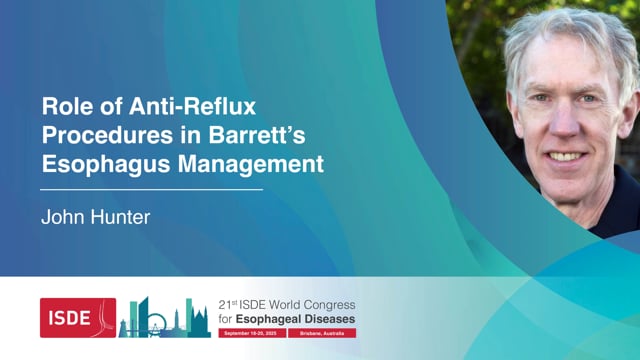
Role of Anti-Reflux Procedures in Barrett’s Esophagus Management – John Hunter
•
4views•
0likes
Listen to Dr. John Hunter present during the State of the Art Management of Barrett’s Esophagus Session, held during the 2025 ISDE World Congress in Brisbane, Australia, from September 18-20, 2025. Watch all presentations in this session, ...
Log in to watch
Locally Advanced Esophageal Cancer - Beyond Clinical Trials
•
1views•
0likes
Locally advanced esophageal cancer, particularly adenocarcinoma, is increasingly diagnosed in patients under 50, with a notable rise in cases among black and Hispanic individuals. The session discusses treatment challenges, survival outcomes, ...
Log in to watch
Neoadjuvant chemoradiotherapy vs. perioperative chemotherapy for gastro-esophageal cancer - an international multidisciplinary Delphi consensus study, Hidde Overtoom, Amsterdam UMC, Netherlands
•
0views•
0likes
Listen to Dr. Hidde Overtoom present during the Young ISDE Committee’s 3rd Annual Shark’s Tank for young researchers. Known as the Dragon’s Den in the northern hemisphere, the Shark’s Tank session includes presentations from early-career ...
Log in to watch
Decreasing Morbidity in Video Assisted Esophagectomy with Indocyanine Green Guided Thoracic Duct Delineation – Abhijit Talukdar
•
2views•
0likes
This video demonstrates decreasing morbidity in video assisted esophagectomy with indocyanine green guided thoracic duct delineation. I am presently working as Professor and Head of the department Surgical Oncology at Dr B Borooah Cancer ...
Log in to watch
Long Term PPI Therapy: Controversies in GERD Part 1 with Kerry Dunbar
•
15views•
0likes
Gastroesophageal Reflux Disease (GERD) is the most prevalent esophageal disease. It is a condition affecting up to 20% of the western world and has a significant negative impact in the patient’s quality of life. The typical symptoms are ...
Page 3 of 9