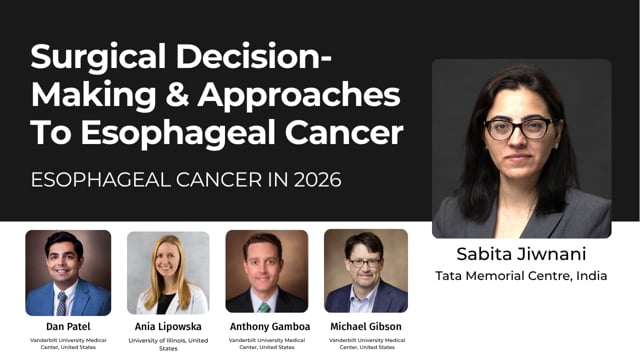
Surgical decision-making & approaches to Esophageal Cancer

Sabita Jiwnani from Tata Memorial Centre (India) discussed surgical decision-making and the benefits of minimally invasive esophagectomy, emphasizing the need for proper patient selection and surgical expertise. The panel agreed that advancements in computer-aided detection, non-endoscopic screening modalities, and personalized oncology therapies will be crucial in the next five years….

Continue reading

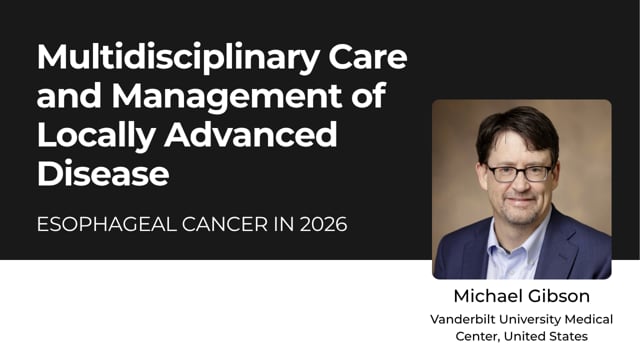
Multidisciplinary Care and Management of Locally Advanced Disease – Michael Gibson

The meeting featured a multidisciplinary discussion on esophageal cancer treatment, with experts from different specialties sharing their approaches and insights. Michael Gibson from Vanderbilt University Medical Center (United States) explained the role of medical oncology in treating locally advanced esophageal cancer, highlighting the importance of combining systemic therapy with surgery…

Continue reading

Esophageal Cancer: Screening and Endoscopic Therapies – Anthony Gamboa

Anthony Gamboa of Vanderbilt University Medical Center (United States) presented on early detection and intervention strategies for esophageal cancer, focusing on Barrett’s esophagus as a precancerous condition. He discussed screening methods including endoscopy protocols and newer non-endoscopic technologies, as well as treatment options for dysplastic Barrett’s using radiofrequency ablation and…

Continue reading

Patient Awareness & Empowering Clinicians – Ania Lipowska

Ania Lipowska of the University of Illinois (United States) presented on patient awareness and empowerment in esophageal cancer care, highlighting the significant delay in seeking care due to low public recognition of dysphagia as a cancer symptom. She discussed the current screening paradigms and their limitations, particularly in identifying younger…

Continue reading

Lymphadenectomy in Salvage Esophagectomy + Q&A – T.S. Rao and Panel

This session addresses the complexities of lymphadenectomy in salvage esophagectomy for recurrent or persistent esophageal cancer. Dr. T.S. Rao discusses the technical and clinical challenges associated with prior treatments such as chemoradiotherapy, highlighting the importance of specialized, high-volume centers. Key topics include complication management, preservation of critical structures such as…

Continue reading

Lymphadenectomy in Esophageal Cancer – Eastern Perspective – Hiroya Takeuchi

Dr. Hiroya Takeuchi provides a detailed overview of the Eastern approach to lymphadenectomy, with a strong emphasis on technical precision and surgical quality. The session explores advanced minimally invasive techniques, including thoracoscopic and robotic-assisted esophagectomy, and demonstrates meticulous mediastinal lymph node dissection—particularly around the recurrent laryngeal nerve. Additional insights include…

Continue reading

Welcome & Context Setting: 2 Field vs 3 Field Lymphadenectomy – CS Pramesh

This opening session from the International Society for Diseases of the Esophagus webinar provides a global overview of lymphadenectomy practices in esophageal cancer. Dr. C.S. Pramesh outlines key differences between 2-field and 3-field lymphadenectomy, emphasizing how regional variation, tumor histology (squamous cell carcinoma vs adenocarcinoma), and evolving perioperative therapies influence…

Continue reading

PCABs: When to Move Beyond PPIs? – Walter Chan

Listen to Dr. Walter Chan present during the Challenges in the Diagnosis and Management of GERD Session, held during the 2025 ISDE World Congress in Brisbane, Australia, from September 18-20, 2025. Watch all presentations in this session, including: Functional Dyspepsia – Relevance to GERD – Gerald Holtmann Assessment of the Potential for GERD and Aerodigestive Morbidity – Prakash…

Continue reading

Endoscopic Interventions and Operative Management – A Surgeon’s Perspective & Panel Discussion – Rishi Reddy

In this session, Dr. Rishi Reddy presents a surgical perspective on the management of esophageal anastomotic leaks, focusing on operative decision-making, infection control, and source control strategies. Topics include drainage techniques, the use of systemic antibiotics, and integration of endoscopic therapies into surgical care pathways. The presentation is followed by…

Continue reading